

Sunday, June 12, 2011
Sketching Experiments
Here's a bit of a replay on yesterday's sketch working with actual board dimensions of 5x7". There will be more coming especially to work out compositional dimensions and placement. But for now, it's a good exercise in layout practice and studying possible lighting. It's a lot of fun as I begin to play around with individual blocks.


Saturday, June 11, 2011
Sacred Geometry: Trinity
One circle makes a Circle.
Two circles make a Vesica Piscis.
Three circles make a Trinity--and three Vesica Piscis.

Here is the pattern more commonly seen in a religious setting. They're within Saint Mary's doors and windows.

And here's a little rough sketch of an idea I have for my egg tempera workshop. I will redraw this up properly with a board and t-square and compass. I suppose I could scale the pear anywhere. Suppose it was only a third that size? Then there's the matter of lighting. I may have to build models...

Two circles make a Vesica Piscis.
Three circles make a Trinity--and three Vesica Piscis.

Here is the pattern more commonly seen in a religious setting. They're within Saint Mary's doors and windows.

And here's a little rough sketch of an idea I have for my egg tempera workshop. I will redraw this up properly with a board and t-square and compass. I suppose I could scale the pear anywhere. Suppose it was only a third that size? Then there's the matter of lighting. I may have to build models...

Friday, June 10, 2011
Vesica Piscis and Saint Mary's Church - Part 2
Quoting and including an image from the Wikipedia article on Vesica Piscis:
Here's a technical drawing I put together as a bridge between the illustration above and the worked over scanned image below. Notice here that the succeeding arcs all build upon the same point (either A or B). On the innermost arcs I let them continue lightly to complete a full vesica piscis.

Now that we have established the mechanics, lets apply this to the main entrance of Saint Mary's Church. To better illustrate I have allowed the arcs to continue all around and darkened the middle arc area. It's all quite on the mark. Sacred geometry at work.

These past few days of visiting and photographing the church and drawing and studying this aspect of sacred geometry has left me sensitive to curves. I begin to notice curves everywhere. Squared off doors and windows of "regular" buildings feel plain and disappointing.
"The vesica piscis is a shape which is the intersection of two circles with the same radius, intersecting in such a way that the center of each circle lies on the circumference of the other."
Vesica Piscis - Wikipedia
"The mathematical ratio of the width of the vesica piscis to its height is the square root of 3."

Here's a technical drawing I put together as a bridge between the illustration above and the worked over scanned image below. Notice here that the succeeding arcs all build upon the same point (either A or B). On the innermost arcs I let them continue lightly to complete a full vesica piscis.

Now that we have established the mechanics, lets apply this to the main entrance of Saint Mary's Church. To better illustrate I have allowed the arcs to continue all around and darkened the middle arc area. It's all quite on the mark. Sacred geometry at work.

These past few days of visiting and photographing the church and drawing and studying this aspect of sacred geometry has left me sensitive to curves. I begin to notice curves everywhere. Squared off doors and windows of "regular" buildings feel plain and disappointing.
Thursday, June 9, 2011
Vesica Piscis and Saint Mary's Church - Part 1
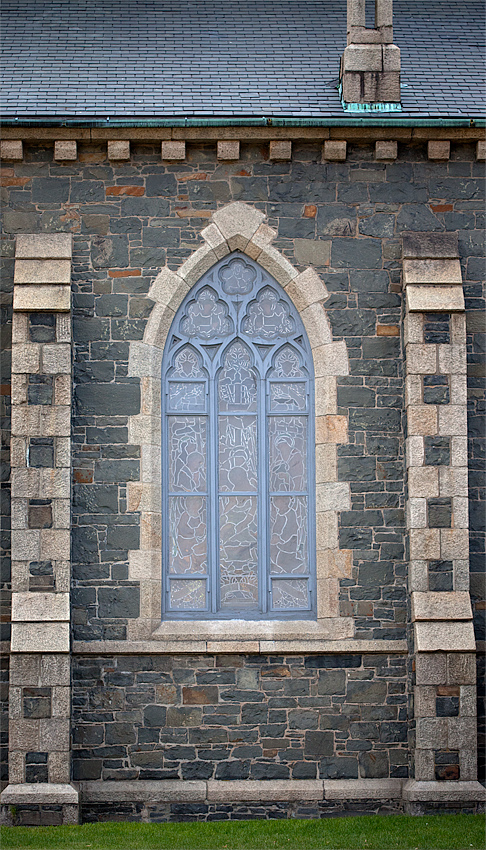
Last weekend on my way to pickup Timothy's food from the vet (he's on a special diet after a couple of urinary blocks some years ago), I noticed the shapes of the doors and windows of Saint Mary's Church in Taunton. Last night I returned for photos.
Late this evening I have printed some of the images and applied a few lines and then the compass. All I can say is that I know I must check my work but I can't help but be excited. If I'm working things right, I have found vesica piscis in this architecture.
Tomorrow I will redo my work and if all holds up will scan and present the results.
 |
| This photo from Wikipedia. Below are my shots. |
Late this evening I have printed some of the images and applied a few lines and then the compass. All I can say is that I know I must check my work but I can't help but be excited. If I'm working things right, I have found vesica piscis in this architecture.
Tomorrow I will redo my work and if all holds up will scan and present the results.
 |
| A perfect fit |
 |
| Not tested |
 |
| My favorite but doesn't seem to fit sacred geometry |
 |
| Above the main entrance |
 |
| Not tested |
 |
| Main entrance - another perfect fit |
Wednesday, June 8, 2011
Yarrow
Common Yarrow, Achillea millefolium, of the Aster (Asteraceae) family is a familiar wildflower around the lake. I have recently and quite accidentally stumbled upon insects in relationship with flowers. I notice many tree leaves already munched on. It all puts me in awe of the interdependence of the species, of how this dance all works in harmony.


Tuesday, June 7, 2011
Silvery Cinquefoil
This evening brings a new discovery! Silvery Cinquefoil, Potentilla argentea, of the Rosaceae (Rose) family.


 |
Monday, June 6, 2011
Lessons Learned
Yesterday's fern work was a fine learning experience.
I'd really not considered my support when I mixed my pigments with chalk and watercolor medium. The milkweed paper is so very rough that a light consistency paint had little chance to attach. Acrylic paint, applied to the ferns thickly with a 3" brush, bound and filled nicely.
I most often mixed a tube color with titanium white, sometimes adding another color. My mixing took place on palette simply by spreading the paints around with my brush. All the streaks of paint looked so fantastic but were lost to a homogeneous hue when brushed onto the fronds. Not sure how I could keep that wonderful detailing.
Using the same frond proved advantageous as after a couple of layers of acrylic dried out, stiffness and durability increased, leaving me to wonder if it wouldn't be good idea to precoat and let dry as a primer.
As the fronds were so big, I was concerned about paint drying before I could completely cover it and spritzing helped there.
Negative painting might be interesting. I could probably use a light consistency paint and throw it with a brush. I wonder about airbrushing?
Just generally random thoughts...
I'd really not considered my support when I mixed my pigments with chalk and watercolor medium. The milkweed paper is so very rough that a light consistency paint had little chance to attach. Acrylic paint, applied to the ferns thickly with a 3" brush, bound and filled nicely.
I most often mixed a tube color with titanium white, sometimes adding another color. My mixing took place on palette simply by spreading the paints around with my brush. All the streaks of paint looked so fantastic but were lost to a homogeneous hue when brushed onto the fronds. Not sure how I could keep that wonderful detailing.
Using the same frond proved advantageous as after a couple of layers of acrylic dried out, stiffness and durability increased, leaving me to wonder if it wouldn't be good idea to precoat and let dry as a primer.
As the fronds were so big, I was concerned about paint drying before I could completely cover it and spritzing helped there.
Negative painting might be interesting. I could probably use a light consistency paint and throw it with a brush. I wonder about airbrushing?
Just generally random thoughts...
Sunday, June 5, 2011
Ferns on Milkweed Paper
Yesterday's preparations were quickly tossed by the wayside when the paint resisted application--too thin and not enough. Out came the Golden acrylics, big gobs of the paints mixed right on the palette with a house painting brush. That thick, luscious paint went so nicely on my cinnamon fern fronds.
 |
| Cinnamon Fern |
 |
| Milkweed paper mounted on foamcore |
 |
| First color applied |
 |
| Next color applied |
 |
| Final two colors applied |
Saturday, June 4, 2011
Preparations
I've been inspired to try something completely different!
In order to get prepared, I needed to set up a few earth tones for the project. You will notice that besides the usual ingredients for mixing watercolors, pigment and medium, there's a bag of chalk. I'm thinking that the chalk, a possible ingredient in gouache, will add opacity.

I didn't bother mulling as the palette knife seemed to work well. Perhaps if my pigments hadn't been previously dispersed, a muller would have been needed to make a proper mix.

Here are my colors all set for tomorrow. My plan is to stamp cinnamon fern fronds on to a 20" x 32" sheet of milkweed paper. More tomorrow!

In order to get prepared, I needed to set up a few earth tones for the project. You will notice that besides the usual ingredients for mixing watercolors, pigment and medium, there's a bag of chalk. I'm thinking that the chalk, a possible ingredient in gouache, will add opacity.

I didn't bother mulling as the palette knife seemed to work well. Perhaps if my pigments hadn't been previously dispersed, a muller would have been needed to make a proper mix.

Here are my colors all set for tomorrow. My plan is to stamp cinnamon fern fronds on to a 20" x 32" sheet of milkweed paper. More tomorrow!

Friday, June 3, 2011
Woodchuck
I'm experimenting with moviemaking and YouTube and Blogger and FeedBurner. But it's all really about my resident woodchuck.
If this video presents problems for you, this direct link may help: http://youtu.be/NrbXd5bK3TE
If this video presents problems for you, this direct link may help: http://youtu.be/NrbXd5bK3TE
Thursday, June 2, 2011
Gretchen Makes The ID!
Gretchen not only supplied the identification but delivered it in a very funny allusion to an old television show that you may remember. Maybe you can guess the species?


So finally, we now know that this is Alfalfa, Medicago sativa. Thanks, Gretchen! It's a member of the pea family, Fabaceae, which Joyce correctly identified. Thanks, Joyce!


Here's your clue!
Did you get it? If not, try here.
This afternoon I went back for more photos, this time with the macro flash to bring out some detail. It was terribly windy and these plants were getting blown over--not very strong compared to the surrounding field grasses.


So finally, we now know that this is Alfalfa, Medicago sativa. Thanks, Gretchen! It's a member of the pea family, Fabaceae, which Joyce correctly identified. Thanks, Joyce!


Wednesday, June 1, 2011
A Couple Of Revisits
I've recently been asking myself how it is that I am discovering new wildflower species. After all, shouldn't I have come upon them within the past two years? I guess there are always new discoveries!
Today, though, I get to present a couple of previously found species.
Today, though, I get to present a couple of previously found species.
 |
| Wool Sowers Gall |
 |
| Painted Turtle, Chrysemys picta, laying eggs. |
Subscribe to:
Posts (Atom)