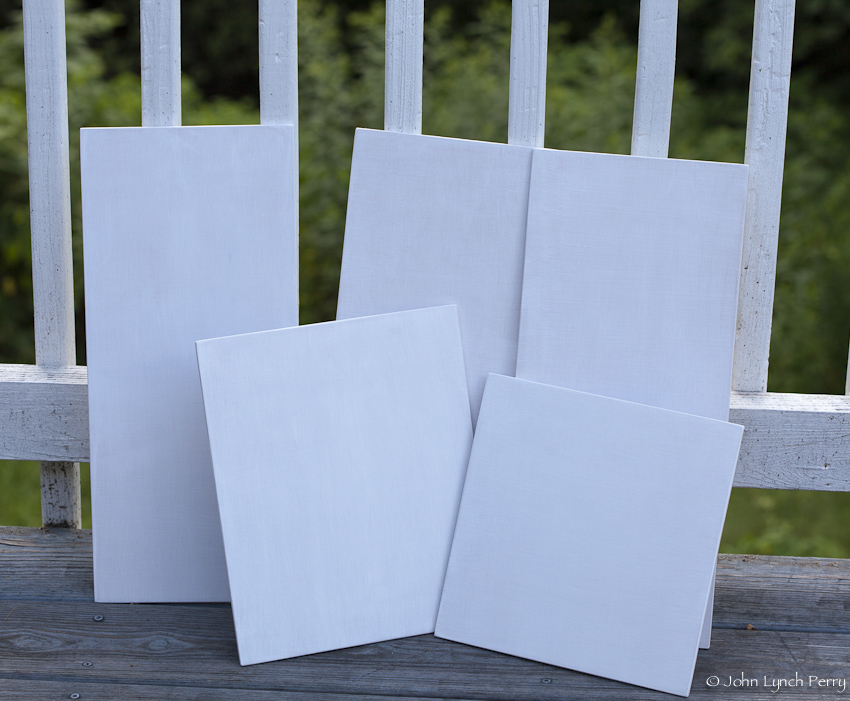
What's a panel? To an oil or acrylic painter, it's an alternative to a canvas support. It could be of solid wood, plywood, MDF (medium density fiberboard), copper or even one of the new composites like Dibond. Sometimes canvas is secured to a panel.
A panel, like a canvas, needs a primer base and then a ground to be considered complete. Examples of primers are rabbit skin glue and acrylic dispersion primers (like Golden's GAC 100.) Examples of grounds are gesso, lead paint and acrylic dispersion grounds (like Golden's Gesso.)
Just those two little paragraphs above open to a world full of knowledge, opinions and outright nonsense. I try to wade through it all with the likes of forums within Natural Pigments and AMIEN. I keep up to date with products and research from the web sites of Golden and Gamblin. Museum sites can be tremendous sources of information for art conservation. (See here and here for starters on these stunning resources.)
I've tried linen panels but prefer a smoother surface. I'm not painting on very large supports, the biggest at this time being 16 x 24 inches. These are my surface and size requirements.
Over the past couple of years, I've tried 1/4" "Birch" plywood from the local building supplier, Home Depot. Splits in the veneer surface and localized warping plagued me.
Home Depot also offers MDF and I've been, until recently, working with their 1/8" MDF. I did find slight warping apparent in sizes over 12 inches.
I have settled on 1/4" MDF. No warping over a span of two feet.
To prepare my panels, I first cut to size on my table saw. Then over the course of a week or so, I will apply two coats of Golden GAC 100 to all sides. Then it's a coat or two of Golden's Gesso all around with a couple more layers for the front. I then let the panels sit for a week or so to dry more completely.
This little process is built upon the product information on Golden's site. It can possibly change over time so I visit regularly. My requests for technical support with Golden's products are always well answered. I like 'em!
You see, my goal here has been to establish a process that I'm comfortable working through and that I feel provides good protection for a painting's future. My standardized process feels "good enough" for me. I like that!
I do as some point want to explore MDFs. Are they all the same? Do some fit better with GAC 100? Perhaps I should scuff up the panel first?
I might want to explore grounds as well. Do I want to use a lead ground instead of acrylic? Will rolling acrylic gesso provide a smoother surface than a brush?
One could easily become lost in the technical abyss and never come out. I do have experience with that phenomenon. I think that's why my "good enough" statement is key here. I may be able to make incremental improvements in my panels but certainly don't need to delay painting. It's good enough!
(See my earlier posts on panel making here and here.)

Showing posts with label panel making. Show all posts
Showing posts with label panel making. Show all posts
Thursday, February 20, 2014


Wednesday, July 4, 2012
Panel Making
I've been back to panel making, inspired by recent conversations with Golden technical support. The following took place over the past five days.
Birch plywood now replaces hardboard (masonite). I had a sheet of 3/16th's laying around. In the future I will probably increase thickness as there was a bit of warping with a couple of the panels. Ya, some were just fine and I don't know why.
After cutting to size came a bit of sanding with 100, 150 and 200 grit to round off the edges and corners and a light scuffing with 200 grit over the entire panels.
I opted to use GAC 100 before applying gesso. I like the idea of isolating the raw support from the gesso. Maybe different woods have varying absorptions? I don't know, but perhaps this helps to take some variables out of the picture.
Birch plywood now replaces hardboard (masonite). I had a sheet of 3/16th's laying around. In the future I will probably increase thickness as there was a bit of warping with a couple of the panels. Ya, some were just fine and I don't know why.
 |
| Birch plywood (3/16") |
 |
| Rounding edge and corner |
Golden's GAC 100 dries to a tacky touch. Stack panels and they will stick slightly together, coming apart with a clicky grip. There is no sanding to be done with this stuff. Brings the grain out nicely, doesn't it?
In the previous post we found that the new sandable gesso does not need base coats of regular gesso. I still have the old stuff here so needed to firstly apply a couple of coats of "regular" gesso. There was no sanding with these coats.
My workflow is to lay out the panels and walk them to my painting station one by one. Paint a side and put it back. Once done, restart with the other side. It helps to assure me that I equally coat all sides. The gesso products dry to touch so quickly that I can paint nonstop.
Here are the first two coats of sandable gesso. I experimented with various toning media. Acrylics behaved just as nicely as aqueous dispersions. Wish I would have had a tube of deep dark acrylic. It takes a lot of pigment to pull down that gesso. I now think of it as white paint!
 |
| Two coats of Golden GAC 100 |
 |
| Two coats of Golden Gesso |
 |
| Keeping order |
I let these first two layers of sandable gesso dry for a day and then sanded with 150 grit to remove most brush marks. The surface was already quite smooth but I just wanted to knock it down a bit. Must one wait a whole day before sanding? Perhaps an hour or so would be adequate. Not sure...
Here I tested dry pigments premixed with water using a palette knife. Although the pigment appeared to be well mixed...
When I began applying sandable gesso toned with my mixed pigment I was in for a big surprise. The gesso went on very light with dark streaks. Essentially I was mixing my paint on the support! I considered halting work to properly mull the gesso but kept on, eventually applying two coats front and back to all panels.
It will be well worth my time to try mulling pigment (that is, rather than just mixing with palette knife) and mixing with sandable gesso. I use my dry pigments for many purposes already so why not use them here as well? I thought I'd prefer acrylic in a tube but I'm leaning back to my old friends. (I recently inventoried my pigment collection--over 60 of them!)
And here's my results! Tomorrow I will give them a light sanding with 150 grit to level them off. I may go to 200 or higher grit with a few as I begin experimenting with first applications of oil paint.
 |
| Toned with Golden Acrylic (left) and toned over with aqueous dispersion (right) |
 |
| Mixing wetted pigment with Golden Sandable Gesso |
It will be well worth my time to try mulling pigment (that is, rather than just mixing with palette knife) and mixing with sandable gesso. I use my dry pigments for many purposes already so why not use them here as well? I thought I'd prefer acrylic in a tube but I'm leaning back to my old friends. (I recently inventoried my pigment collection--over 60 of them!)
 |
| Streaking pigments |
 |
| Final coats drying |
Thursday, June 28, 2012
Panel Making
For some time I've been experimenting with panel making to support oil paints. I thought I had a good process down but still had a few questions. As I am using Golden products, I turned to their technical support to help me out.
Here is my query to Golden Technical Support:
And here is Golden's reply:
My follow-up responses:
I'll be documenting my adjusted panel making in a later post. I have plywood to cut and a proper color of acrylic paint to select. I've learned that even with an established process, it must be revisited to keep up with product changes.
. . .
I am making panels for oil painting only--no other media. I begin with masonite which I lightly scuff and then apply two coats of GAC 100, then two coats of Acrylic Gesso and finally a few coats of Sandable Acrylic Gesso. My goal is to achieve a smooth surface and I'm pleased with my initial results.
I do have a few questions that I hope you can answer:
-- For oil painting only, should I still first use GAC 100 or can I start right off with Acrylic Gesso?
-- If I should use GAC 100, would GAC 500 work just as well. (I am interested in the self-leveling property.)
-- Do I need to use Acrylic Gesso before applying Sandable Acrylic Gesso? I seem to remember reading that in one of Golden's guidelines for use but cannot now locate it. From what I can find I do not need to use regular gesso before applying sandable gesso.
-- Can I tone Sandable Acrylic Gesso with dry pigments? I have toned the Sandable Acrylic Gesso with a raw umber aquaeous dispersion from Natural Pigments and that seemed to work well. I later read that Golden recommends toning with acrylic paint. I'd like to be able to use my collection of dry pigments if that is possible.
. . .
And here is Golden's reply:
We are not fans of hardboards, generally speaking. 'Hardboard' is the general term for what used to be called masonite, which was a brand of hardboard, not produced anymore, to my knowledge. Hardboards are made with wood dust and a variety of ways of getting them to stick together. Some use resins, some use polymerized oils, etc. The main issue has to do with moisture sensitivity. We think that either Birch Plywood or MDO Plywood are better choices, and that either of those panels would have better dimensional stability. Having said that, many artists are still using hardboards of various sorts. It is possible that certain types are more stable than others, but we do not have that information.
You do not need to be concerned with SID or support induced discoloration if you are painting with oils, so the GAC 100 or another stain blocking primer is not required for that reason. The other reason for using GAC 100 is to block oil absorption into canvas, but I doubt this is a concern with the hardboard. We still like the idea of some kind of separation or primer, and you could use a commercially available one such as Kilz, in either the alkyd or water borne variety, or you could use GAC 100. The newly re-formulated SHG does not require a coat of Gesso first, so you can apply it directly over the GAC 100 ( or 500 if you like, in this instance ), or commercial stain blocking primer.
Yes, assuming you can get the dry pigments to disperse well, you can use small amounts to tint the SHG. Too much may make the mixture have a higher propensity to crack or craze upon drying. The reason we recommend acrylic paints is because dry pigments tend to clump and it is difficult to get then dispersed and homogenized in the material, without using a paint mill or special mixing machine. But, if you feel it is working for you, then by all means go ahead.
Our Sandable Hard Gesso tech sheet is found when you put your cursor over 'Products", then click on 'Gessos and Grounds'. Here it is:
http://www.goldenpaints.com/technicaldata/sandable.php
I hope this information is helpful, and if you have more questions, please don't hesitate to call or email.
. . .
My follow-up responses:
I finally found the reference to first applying regular gesso before sandable--right on the label. So for now I'll stay with my process until I pick up a new jar of sandable gesso.
I hear you on the dry pigments. I suppose I could try to premix pigment with gesso using a palette knife or muller on my grinding glass but I'd be going against the quick drying nature of the gesso. All this instead of a little squeeze of acrylic paint...
. . .
I'll be documenting my adjusted panel making in a later post. I have plywood to cut and a proper color of acrylic paint to select. I've learned that even with an established process, it must be revisited to keep up with product changes.
Subscribe to:
Posts (Atom)